
Can Your Employer Force You Into a Wage Settlement? What the Law Actually Allows


Need an Employment Law Attorney?
Get matched with pre-screened attorneys in your area. Free to use, no obligation.
Get Matched Free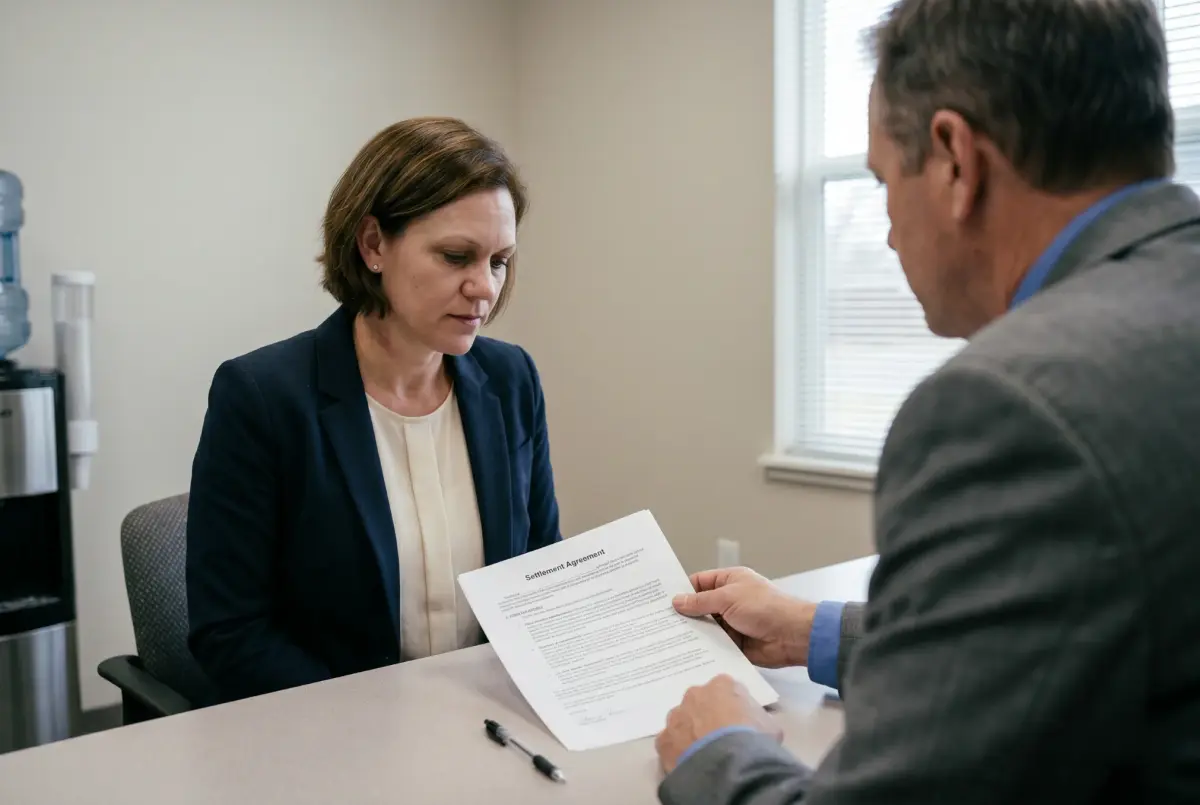
No: your employer cannot legally force you to accept a wage settlement, and under federal law a private settlement of a Fair Labor Standards Act (FLSA) claim is not even valid until a federal judge or the U.S. Department of Labor reviews and approves it. The FLSA is the 1938 federal law that guarantees minimum wage, overtime, and back pay, and it carries a protection most other laws do not: you cannot privately sign away those rights, even if you want to. That rule exists precisely because lawmakers assumed an employer might try to pressure a worker into taking less than they are owed.
If you are staring at a settlement offer and feeling rushed, that pressure is worth taking seriously, but the law is built to give you room. An employer can offer a number. It cannot quietly close the door on a valid wage claim by leaning on you to sign. Knowing where the line sits, and what a court will and will not allow, is what turns a stressful offer into a decision you control.
Why you can't be forced to waive FLSA rights
The reason traces back to how Congress wrote the FLSA. It is a remedial statute, designed to correct the unequal bargaining power between a single worker and an employer. The U.S. Supreme Court recognized this directly in Brooklyn Savings Bank v. O'Neil, 324 U.S. 697 (1945), holding that an employee cannot waive the right to the statute's core protections through a private deal, because doing so would let employers use their leverage to buy out valid claims cheaply.
That is the anti-waiver doctrine, and it has a concrete consequence. There are only two ways to validly release a private FLSA claim: a settlement supervised by the Department of Labor's Wage and Hour Division, or one approved by a federal judge. If an employer pushes a settlement that skips both, the release can be unenforceable, meaning you could, in principle, take the money and still bring a claim for the same unpaid wages. The law treats pressure to sign as exactly the risk it was written to prevent.
What "pressure" actually looks like, and why it doesn't work
Pressure in a wage dispute rarely looks like an overt threat. More often it is a deadline that feels artificial, a settlement papered with intimidating boilerplate, or an implication that turning down the offer will make things worse at work. None of that changes the underlying rule. A settlement still has to be voluntary, and in federal court it still has to survive a judge's review before it binds you.
Retaliation for raising a wage complaint is itself unlawful under the FLSA's anti-retaliation provision. An employer who responds to a wage dispute by cutting your hours, demoting you, or firing you is creating a separate legal problem, not strengthening its settlement position. If a settlement offer arrives alongside that kind of treatment, the two issues are connected, and the way the release is written can determine whether you keep the right to act on the retaliation. Wage disputes frequently travel with wrongful termination and retaliation claims, which is one reason the release language matters as much as the dollar figure.
The judge's review is your backstop
In the federal courts of the Second Circuit (New York, Connecticut, and Vermont) the requirement that a judge approve FLSA settlements is categorical. The controlling decision is Cheeks v. Freeport Pancake House, Inc., 796 F.3d 199 (2d Cir. 2015), which held that a private FLSA case cannot be dismissed with prejudice unless a court or the Department of Labor approves the terms. The full opinion is available through the Second Circuit Court of Appeals. The Eleventh Circuit reached the same result decades earlier in Lynn's Food Stores, Inc. v. United States, 679 F.2d 1350 (11th Cir. 1982).
For a worker, this review is a backstop, not a burden. It means a judge, not your employer, has the final say on whether the deal is fair. The strictness does vary by federal circuit, so the exact protection depends on which court your claim sits in; that is a point worth confirming with an employment attorney licensed in your state. But the core principle is broad: a federal wage settlement is not final the moment you sign, and that gap is designed to protect you.
The terms a court will strike from a pressured settlement
When an employer over-papers a settlement to lock a worker down, those very terms are often what a judge rejects. Courts apply a presumption against provisions that undercut the law's public-accountability purpose. The recurring offenders are predictable.
| CLAUSE AN EMPLOYER MAY PUSH | WHY A COURT OFTEN REJECTS IT |
| A release of "any and all claims" | Forces you to give up unrelated rights, like discrimination or retaliation claims, in exchange for wages you were already owed. |
| A confidentiality clause | Courts hold that keeping wage violations secret conflicts with the FLSA's goal of public awareness. |
| A non-disparagement clause | Read as a gag order in disguise and routinely struck as a highly restrictive term. |
| A no-rehire provision | Treated as retaliation by contract unless tied to a specific, documented business reason. |
| An indemnification clause | Shifts the employer's own compliance risk onto you: the opposite of how the law assigns it. |
The pattern is consistent: the harder an employer leans on restrictive language, the more likely a court is to send the deal back. That is leverage in your favor, not theirs.
How a court checks whether the amount is fair
A judge does not just rubber-stamp the dollar figure. Courts in the Second Circuit use a framework from Wolinsky v. Scholastic Inc., 900 F. Supp. 2d 332 (S.D.N.Y. 2012), weighing whether there is a genuine dispute, whether the amount is fair, whether attorney fees are reasonable, and whether any terms frustrate the law's purpose. On the amount, the court typically wants to see your maximum potential recovery, the settlement net of fees, and what percentage of the maximum you would actually keep.
Settlements in the range of roughly one-quarter to one-third of the best-case recovery are commonly approved when the facts are genuinely disputed. A figure far below that (without a clear explanation of why your case carried unusual risk) draws scrutiny. So a pressured "take it now" offer that comes in low is not just ethically questionable; it is the kind of deal a federal judge is most likely to question.
Attorney fees, and why they protect you too
One quiet protection in FLSA settlements is that the judge reviews attorney fees independently. The Second Circuit addressed this in Fisher v. SD Protection Inc., 948 F.3d 593 (2d Cir. 2020). The decision is often described as cracking down on fees, but the holding is more nuanced. The court rejected a rigid rule that would cap fees at a fixed share of your recovery, reasoning that such a cap discourages attorneys from taking smaller wage cases at all. It also held that a court cannot rewrite a settlement to redistribute the money itself: it must return an unreasonable agreement to the parties to renegotiate. The practical effect is that fee scrutiny stays in place, but the rule does not punish workers with smaller claims by making lawyers reluctant to represent them.
State law can change the calculation
Federal court is not your only option. Many states have their own wage-and-hour laws, and some are more generous than the FLSA, longer filing windows, automatic damages, or extra penalties for missing pay notices. A worker whose job and employer are entirely within one state sometimes has the choice to sue under state law alone. That can mean a larger potential recovery, and it changes which approval rules apply. Whether the state or federal route serves you better is fact-specific, and it is one of the first questions an attorney will work through with you.
Your move when an offer feels rushed
If a settlement offer feels like pressure, treat that feeling as a signal to slow down, not speed up. Do three things before you sign. First, get the math: compare the offer, after fees, to a realistic estimate of your maximum recovery. Second, read every non-monetary term: a confidentiality or broad-release clause can cost you more than a gap in the payout, and many of those terms a court would strike anyway. Third, confirm which law and which court your claim falls under, because your deadlines, your damages, and the approval rules all turn on it. You are not obligated to accept the first number, and the law does not let an employer treat your signature as the only way out. If you want a fast, specific read before you respond, you can describe your situation and get an instant case evaluation, or search for an employment law attorney on AttorneyReview.com to review the offer with you.
Frequently Asked Questions
Can my employer legally force me to sign a wage settlement?
No. A wage settlement must be voluntary, and under the FLSA a private settlement is not valid unless a federal judge or the Department of Labor approves it. An employer can make an offer, but it cannot force you to accept one or treat a pressured signature as a binding release.
What if I already signed a settlement under pressure?
If the release covered FLSA claims and was never approved by a court or the Department of Labor, it may be unenforceable. Whether that applies to your situation depends on the specific terms and the venue, so it is worth having an employment attorney review what you signed.
Is it illegal for my employer to retaliate after I raise a wage complaint?
Yes. The FLSA prohibits retaliation against a worker for asserting wage rights. Cutting hours, demoting, or firing a worker in response to a wage complaint can create a separate legal claim on top of the wage dispute.
Can my employer make the settlement confidential?
In federal FLSA settlements, broad confidentiality clauses are routinely rejected because courts view secrecy as conflicting with the law's purpose. Some judges allow only the dollar amount to be kept private; many strike confidentiality entirely.
What happens if I refuse the offer?
Refusing a settlement offer is your right, and it is not a basis for lawful retaliation. The case continues, and you remain free to negotiate or to have a court decide the claim. An artificial deadline attached to an offer does not change your legal position.
How do I know if the amount being offered is fair?
Compare the offer, net of attorney fees, against the maximum you could recover if every disputed hour were proven. In genuinely contested cases, courts commonly approve settlements around one-quarter to one-third of the maximum; a much lower figure usually needs a strong explanation.
Does a judge always review the settlement?
Private FLSA settlements filed in federal court generally require approval from a judge or the Department of Labor. Settlements under some state wage laws, in state court, may not carry the same requirement, which is one reason the choice of venue matters.
Will I have to appear in court for the approval?
Usually not. Most fairness reviews are decided on written submissions. An in-person hearing is the exception, typically when the court has a specific concern about fees or a restrictive term.
Can I bring my claim under state law instead?
Often, yes. Many states have their own wage-and-hour statutes, some with stronger remedies than the FLSA, and suing under state law alone can keep a case out of the federal approval framework. Which path is better depends on the facts and your state's law.
Should I talk to a lawyer before responding to a settlement offer?
Reviewing an offer means comparing it to your potential recovery, checking the release terms, and confirming the right venue and deadlines. An employment attorney licensed in your state can tell you whether the offer is fair and whether the terms protect your other rights.
Disclaimer
Readers should consult a qualified attorney licensed in their jurisdiction.This content is for general informational purposes only, is not legal advice, and does not create an attorney-client relationship. AttorneyReview works with a network of law firms across the United States. If you need help with your case, get matched free with a qualified attorney.
If your employer has offered a wage settlement or you believe you have been underpaid, you can search for an employment law attorney on AttorneyReview.com. You can also use the Get Matched tool to connect with an attorney who handles wage-and-hour cases.
Need an Employment Law Attorney?
Get matched with pre-screened attorneys in your area. Free to use, no obligation.
Get Matched Free