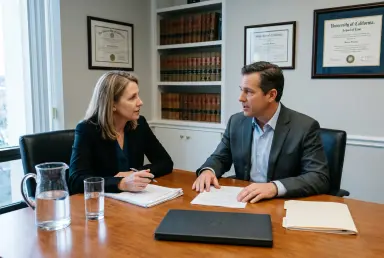
Setting Client Expectations: Avoid This Pitfall

Are You an Attorney?
Join AttorneyReview, claim your free profile, and connect with clients in your practice area.
Claim Your Profile
The single most common mistake attorneys make in the first client meeting isn't missing a legal detail. It's failing to explicitly manage expectations — and letting the gap between what a client hopes for and what the legal process can actually deliver go unaddressed until it becomes a complaint.
That gap is expensive. It erodes trust, generates friction, invites bar complaints, and chips away at the referral base that sustains a practice. The good news is that it's almost entirely preventable — and the fix starts before the retainer is signed.
Why Expectations Go Sideways
Clients arrive at a lawyer's office carrying an emotional load: fear, anger, desperation, or all three at once. They are seeking resolution, often urgently, and they may not understand the timelines, costs, or procedural realities of what lies ahead. When an attorney says "we will pursue all available avenues," a client in that state of mind may hear "we will win, quickly, and cheaply." The attorney meant to be thorough. The client heard a promise.
This is not a failure of intelligence on the client's part. It's a predictable feature of how people process information under stress. Understanding that goes a long way toward designing an intake process that accounts for it — rather than one that assumes clients heard and retained everything discussed in a single meeting.
The data reinforces the stakes. According to Clio's 2024 Legal Trends Report, a secret shopper study of 500 U.S. law firms found that 73% of prospective clients who contacted firms were unlikely to recommend them — largely because of communication failures in those first interactions. In phone conversations, only 36% of firms could explain the legal process or outline next steps. Only 18% of email responses addressed next steps or expected costs. The first impression problem is real, and it begins well before the case gets complex.
Setting Clear Expectations From the First Meeting
Managing expectations is not about dampening a client's hope. It's about building a shared, honest picture of the engagement from the start — so that when the process is slow, or complicated, or doesn't end exactly as the client imagined, the attorney-client relationship survives it.
Five areas deserve explicit attention in every initial meeting.
Grow your practice...
Are You an Attorney?
Join AttorneyReview, claim your free profile, and connect with clients in your practice area.
The scope of representation should be defined precisely in plain language. What legal services are actually being provided — litigation, negotiation, document review, advisory? What outcomes are plausible, and which are not? Clients routinely assume that hiring an attorney for a divorce or a personal injury claim means a particular outcome is guaranteed. It doesn't. Saying so clearly, early, is not pessimistic. It's honest, and it's protective — for the client and for the attorney.
Timelines should be communicated as ranges, not promises. Walk clients through the typical phases of their type of case — intake, investigation, discovery, negotiation, potential trial — and be explicit that external factors outside anyone's control routinely affect timing. A client who knows a case might take 18 months and understands why is far more resilient than one who expected six months and wasn't told otherwise.
Fee transparency goes beyond handing over a retainer agreement. Explaining how costs accrue — what activities are billable, what the billing cycle is, what kinds of developments typically drive costs up — reduces sticker shock later and the disputes that follow it. Clients who understand why the bill is what it is rarely complain about the amount the way clients who feel blindsided do.
Communication protocols should be set proactively, not reactively. Specify your preferred methods of contact, your typical response windows, and who handles routine inquiries. A client who knows to expect a response within 24 hours will wait 24 hours. A client who was never told will start to worry after two.
Client responsibilities need to be spelled out. What documents do you need, and when? What is their role during discovery? What decisions will require their timely input? Framing the engagement as a partnership — where both sides have obligations — changes the dynamic from one where the attorney is simply performing a service for a passive client to one where both parties are working toward a shared goal.
What the Most Effective Attorneys Actually Do
Attorneys who consistently generate high satisfaction scores and strong referral volume don't treat expectation management as a single conversation. They build it into the structure of the engagement itself.
One approach that works in personal injury practices is a simple one-page "Client Journey Roadmap" — a visual that lays out the typical stages of a claim from intake through resolution, marks where delays commonly occur, and shows when the client should expect to hear from the attorney at each phase. Walking through this document in the first meeting transforms the "how long will this take?" question from an anxiety point into a shared frame of reference.
In family law, some attorneys include a brief "What We Cannot Do" document alongside the retainer — an explicit list of common client misconceptions and requests that fall outside the scope of representation or legal ethics. "We cannot guarantee a specific outcome." "We cannot contact your spouse directly outside of proper legal channels without your consent." Clients sometimes find this directness surprising at first. What they find, over time, is that the attorney who told them the truth early is the one they trust — and recommend.
Both approaches reflect the same underlying principle: clarity given early is far cheaper than clarity extracted through conflict later.
Mistakes That Quietly Cost Attorneys
Even experienced attorneys fall into patterns that undermine the expectations they're trying to set.
Overpromising — through phrases like "this is a strong case" or "we will fight vigorously for you" — is often well-intentioned. But clients in distress hear those phrases as guarantees. When the outcome falls short of what that language implied, the disappointment tends to be attributed to the attorney rather than to the complexity of the law.
Assuming comprehension is a close second. Legal concepts are second nature to attorneys and foreign to almost everyone else. A client who nods through an explanation of discovery timelines may have understood none of it. Confirming understanding — asking the client to reflect back what they heard, offering a written summary after the meeting — is not condescending. It closes the gap.
Avoiding difficult conversations early amplifies them later. The moment to discuss risk, realistic outcomes, and the possibility of a less-than-ideal result is the first meeting — not the day before trial. Clients who are prepared for all scenarios make better decisions and place less blame when things don't go their way.
Inconsistent follow-through after an initial meeting can undo everything that was established in it. Even when there is no new development to report, a brief update — "we're still in discovery, nothing to report yet, but I wanted you to hear it from me" — sustains trust through the slow phases of a case. Silence, in the absence of an established communication protocol, reads as neglect.
The Practice Growth Case for Getting This Right
Client satisfaction in legal practice is downstream of expectation management. A client who received exactly what they were told to expect — even in a case with an imperfect outcome — tends to feel well-served. A client who received a better result than anticipated but was poorly communicated with tends to feel neglected. The outcome matters, but the relationship built around it matters just as much.
Satisfied clients generate referrals. Dissatisfied clients generate bar complaints, negative reviews, and attrition. The difference between the two is often not how skillfully the law was practiced — it's how clearly the engagement was framed from the start. Attorneys who treat the first meeting as a strategic communication moment, not just a legal intake, build practices that compound over time.
Frequently Asked Questions
How do I tell a client their expectations are unrealistic without alienating them?
Anchor your response in the realities of the legal system rather than in the client's hopes. Explain what is legally feasible, what courts have done in comparable cases, and what your professional duty requires you to advise. Framing it as "the system works this way, and my job is to make sure you know that" is very different from "you're wrong." Clients can accept disappointing information when they feel it's being shared in their interest — not used to dismiss them.
Should I discuss potential negative outcomes in the first meeting?
Yes, always. Discussing risk and potential negative outcomes is one of the most valuable things you can do in the first meeting. It demonstrates honesty, sets up the client's decision-making on a realistic foundation, and protects you if the case doesn't unfold favorably. Clients who were prepared for difficult outcomes rarely blame the attorney. Clients who weren't often do.
What if a client still insists on unrealistic expectations after I've explained the situation clearly?
Re-evaluate whether this engagement serves either party. If a client cannot accept the realistic scope of what legal representation can deliver after clear, good-faith explanation, the conflict will surface again — at a more expensive, more consequential moment in the case. Declining a representation in that situation is not a loss. It's the exercise of sound professional judgment.
How can I make sure my fee structure is actually understood?
Provide a written fee agreement that is genuinely readable — not a dense document handed over and assumed absorbed. Dedicate time in the first meeting to walk through it section by section, explain what triggers additional costs, and invite questions. If your billing structure is complicated, a simple visual summary alongside the formal agreement does more to prevent disputes than any legal language in the agreement itself.
How often should I update clients when there's nothing new to report?
Regularly — and more often than you think is necessary. A brief check-in during a quiet phase of a case ("nothing new to report, but we're on track") costs almost nothing and sustains a level of trust that goes silent phases can erode quickly. The Clio 2024 Legal Trends Report found that 48% of law firms were essentially unreachable by phone when prospective clients reached out. Existing clients notice the same pattern. Proactive communication is a differentiator, not a nicety.
Is there a way to document expectation conversations so they're on record?
Yes — and it's worth building into your standard intake process. A brief follow-up email after the first meeting that summarizes what was discussed — scope, timeline estimates, billing structure, communication protocols — creates a written record that protects both the attorney and the client. It also gives the client something to reference later, which reduces the "but I thought you said…" conversations that erode trust over time.
Disclaimer
This content is for general informational purposes only, is not legal advice, and does not create an attorney-client relationship.
Are you an attorney looking to grow your practice and connect with clients who are ready to hire? Claim your profile on AttorneyReview.com and reach clients actively searching for legal representation in your practice area.
Are You an Attorney?
Join AttorneyReview, claim your free profile, and connect with clients in your practice area.
Claim Your Profile