Blackstone Parmesan Ranch Recall: Your Legal Options if You Got Sick After Walmart

Need a Personal Injury Attorney?
Get matched with pre-screened attorneys in your area. Free to use, no obligation.
Get Matched Free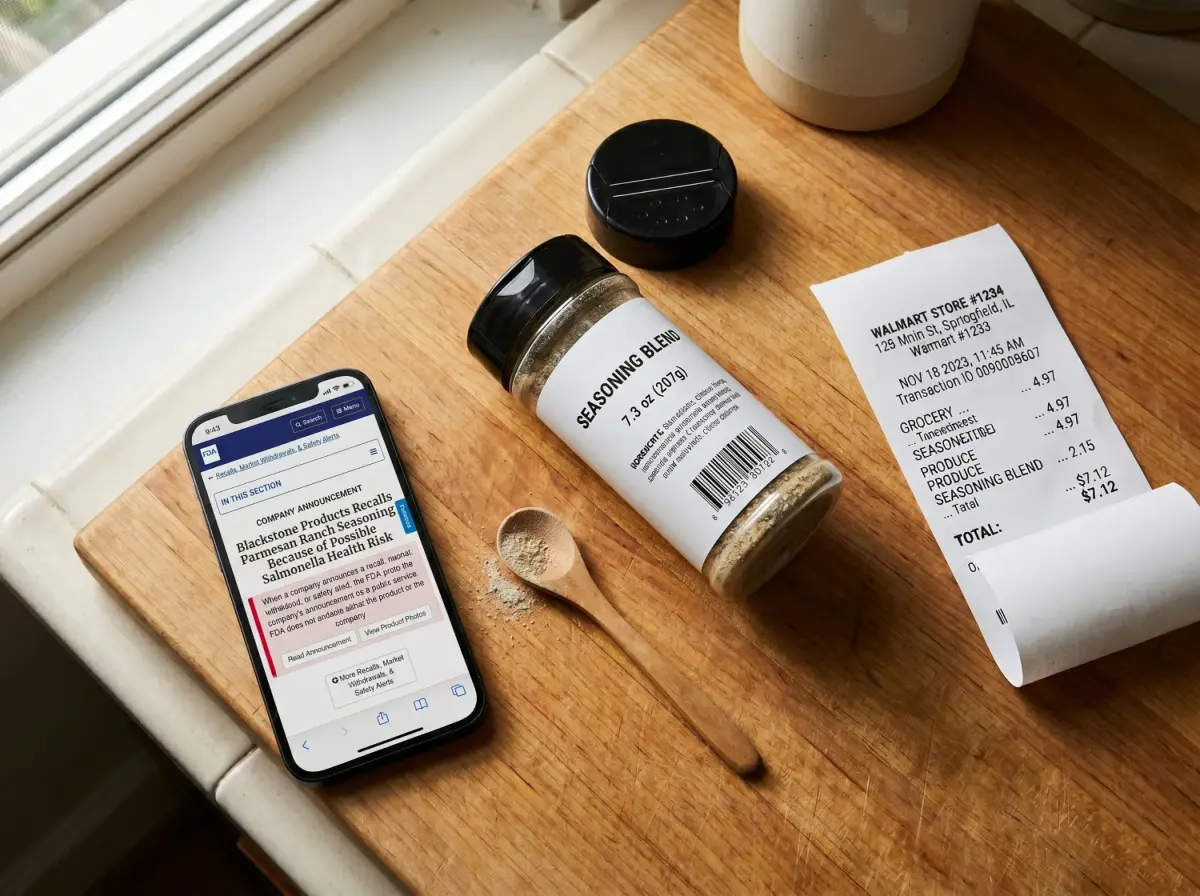
If you got sick after eating something made with Blackstone Parmesan Ranch seasoning from Walmart, you may have a product liability claim — and the legal clock starts the day your symptoms appeared, not the day the recall was announced. Most states give food poisoning victims between one and four years to file suit, but the evidence you need to actually win disappears in days if you don't preserve it correctly.
On May 15, 2026, the U.S. Food and Drug Administration announced that Blackstone Products of Providence, Utah voluntarily recalled three lots of its Parmesan Ranch 7.3-ounce seasoning sold exclusively at Walmart stores nationwide and on the Blackstone website. The recall traces back to contaminated dry milk powder supplied by California Dairies. No illnesses had been reported as of mid-May, but the affected product carries best-by dates extending to August 2027, meaning contaminated containers may still be sitting in consumer pantries more than a year from now.
What follows is what your legal rights actually look like, who you can sue, and what to do right now if you got sick.
Which Products the Recall Covers
The affected item is Blackstone Parmesan Ranch seasoning in 7.3-ounce containers, item #4106. Three specific lot codes are subject to the recall: 2025-43282 (best by July 2, 2027), 2025-46172 (best by August 5, 2027), and 2026-54751 (best by August 12, 2027). The lot code and best-by date appear on the bottom of the container. You can verify whether your seasoning is part of the recall directly on the FDA Recalls, Market Withdrawals, & Safety Alerts page.
The contamination did not start with Blackstone Products itself. According to the FDA notice, the cause was contaminated dry milk powder that Blackstone received from California Dairies, which was then used by a third-party manufacturer that actually produced the seasoning. That supply chain — California Dairies, the third-party manufacturer, Blackstone Products, Walmart — matters legally, because each link in the chain is a potential defendant.
The Legal Theory: Strict Product Liability
Food poisoning lawsuits in the United States are usually brought under three legal theories: strict product liability, negligence, and breach of warranty. Strict product liability is the most powerful for plaintiffs because it does not require proof that the defendant was careless.
Under the rule set out in Restatement (Second) of Torts § 402A — which the vast majority of states have adopted in some form — a seller of a defective product that is unreasonably dangerous to the consumer is liable for harm caused by the defect, regardless of how much care the seller exercised in preparing or selling it. Food contaminated with salmonella is, by definition, unreasonably dangerous. A sick consumer does not have to prove that Walmart, Blackstone, or California Dairies was negligent. The consumer only has to prove that the product was defective when it left the defendant's control, that the defect made it unreasonably dangerous, and that the defect caused the illness.
Who You Can Sue
Under strict product liability, every commercial entity in the chain of distribution can be held liable. For a contaminated seasoning case, that potentially includes:
- The retailer — Walmart, which sold the product directly to consumers.
- The brand owner — Blackstone Products of Providence, Utah, which labeled and distributed the seasoning.
- The third-party manufacturer — the contract manufacturer that actually produced the seasoning using the contaminated milk powder.
- The ingredient supplier — California Dairies, which supplied the dry milk powder identified as the source of the contamination.
Joining multiple defendants is standard practice in food liability cases because it ensures at least one defendant with adequate insurance and assets is on the hook, and because it forces the defendants to litigate against each other over apportionment of fault.
What You Have to Prove — and the Evidence That Wins
To recover damages, you need to connect three dots: (1) the food was contaminated, (2) you ate that specific food, and (3) the contamination caused your illness. Each link requires specific evidence.
Proving contamination is the easiest piece. The FDA recall notice and lot-specific identification do most of this work. If you have a container with one of the three recalled lot numbers, the contamination element is essentially conceded by the recall itself.
Proving consumption is where most cases are won or lost. The single most important piece of evidence is a stool culture confirming salmonella, taken close in time to the illness. A culture that matches the strain identified in the FDA traceback investigation creates a near-conclusive link. Receipts, Walmart loyalty-card history, photographs of the container, and credit card statements all matter.
Proving causation comes down to timing. Salmonella symptoms — fever, diarrhea, nausea, vomiting, abdominal cramping — typically appear between six hours and six days after exposure, according to the CDC's salmonella symptom guidance. A medical record showing onset within that window, taken alongside a positive culture, is the gold standard.
What Damages Are Available
A consumer who can prove the elements of a food poisoning claim is entitled to recover the full range of compensatory damages, which typically include:
- Medical expenses — emergency room visits, hospitalization, laboratory testing, follow-up care, and any long-term treatment
- Lost wages — for time missed from work during the acute illness and any extended recovery
- Pain and suffering — physical pain, mental anguish, and reduced quality of life
- Long-term complications — salmonella infections can lead to reactive arthritis, irritable bowel syndrome, and other chronic conditions in some patients
- Wrongful death damages — for surviving family members in fatal cases
Salmonella is not a minor illness for everyone. The CDC estimates that Salmonella causes approximately 1.35 million infections, 26,500 hospitalizations, and 420 deaths in the United States each year. The FDA's recall notice specifically warns that salmonella can cause "serious and sometimes fatal infections in young children, frail or elderly people, and others with weakened immune systems."
If the illness left you with medical bills you cannot pay, you should also know that recent federal rules have changed how medical debt appears on credit reports — paid medical collections are now removed, and there is a one-year waiting period before unpaid medical debt can be reported at all.
Class Action vs. Individual Lawsuit
Recalls of this scale frequently produce both class action lawsuits and individual personal injury cases. The two work differently and aim at different outcomes.
A class action is typically brought on behalf of all consumers who purchased the recalled product, often seeking the purchase price plus statutory damages under state consumer protection laws — even from consumers who never got sick. Class actions are most useful for economic damages, like refunds and reimbursement. AttorneyReview has covered several recent class action settlements and how to file claims.
An individual personal injury lawsuit is brought by a single sick consumer, or a family, seeking the full value of their specific medical bills, lost wages, and pain and suffering. Individual cases are far more valuable per plaintiff than class action recoveries, but they require the plaintiff to actually have been sick and to prove it.
A consumer who was sickened by a recalled product should almost always pursue an individual case rather than waiting for a class action settlement to compensate them for a hospitalization. Once an individual case settles or goes to verdict, the consumer is typically released from any related class action.
State Statutes of Limitations for Food Poisoning Claims
Food poisoning claims fall under each state's personal injury statute of limitations, which varies:
- One year: Kentucky, Louisiana, Tennessee
- Two years: Alabama, Arizona, California, Colorado, Connecticut, Delaware, Georgia, Hawaii, Idaho, Illinois, Indiana, Iowa, Kansas, Minnesota, Nevada, New Jersey, Ohio, Oklahoma, Oregon, Pennsylvania, Texas, Virginia, West Virginia
- Three years: Arkansas, the District of Columbia, Maryland, Massachusetts, Michigan, Mississippi, Montana, New Hampshire, New Mexico, New York, North Carolina, Rhode Island, South Carolina, Vermont, Washington, Wisconsin
- Four years: Florida, Nebraska, Utah, Wyoming
- Six years: Maine, North Dakota
The clock generally starts running on the date of injury — that is, the date you became ill — not the date of the recall. If you became ill from a different food product months before the May 2026 recall but only now suspect the seasoning was the cause, consult an attorney immediately, because your deadline may already be running.
What to Do in the First 48 Hours
If you used a recalled lot of Blackstone Parmesan Ranch seasoning and developed symptoms of salmonella infection, the next 48 hours matter more than the next six months:
- See a doctor and request a stool culture. A positive culture genotyped to the outbreak strain is the most valuable piece of evidence in any food poisoning case.
- Do not throw away the container. Keep the seasoning container — with the lot code visible — sealed in a plastic bag. This is the single most important physical evidence in the case.
- Save your receipt and Walmart purchase history. If you paid with a credit card or a Walmart account, the purchase record is recoverable. Pull it now.
- Photograph everything. Photograph the container, the lot code, the meals you prepared, and any visible symptoms.
- Report to the FDA. Filing a report through the FDA's Safety Reporting Portal creates a federal record of your illness and adds to the agency's traceback data.
- Keep every medical record and bill. Every visit, every prescription, every test.
- Calendar your state's statute of limitations. Use the date you first became ill as the trigger date.
If you are not sure whether your situation rises to the level of a product liability claim, you can describe what happened and get an instant case evaluation identifying the type of attorney best suited to help.
What Walmart and Blackstone Will Argue
Defendants in food poisoning cases typically run one of four defenses: that the product was not the cause of the illness, that the plaintiff has no proof of consumption, that the statute of limitations has expired, or that an intervening cause — such as cross-contamination in the consumer's own kitchen — broke the chain of causation.
The strongest of these is the proof-of-consumption defense, and it is also the easiest to defeat with a preserved container, a receipt, and a stool culture matched to the outbreak strain. A consumer who has all three has effectively foreclosed the most common defense before it is raised. That is why the first 48 hours matter so much.
The Decision to Make Right Now
If you used a recalled lot and got sick, your decision in the next two weeks is not whether to file a lawsuit — it is whether to preserve the evidence that would let you file one later. Hold onto the container. Request the culture. Save the receipt. Document the medical visits. Those four things cost nothing and take an hour. Without them, a strong case becomes a weak one regardless of how good your attorney is.
Frequently Asked Questions
Can I sue if I got sick from the recalled Blackstone Parmesan Ranch seasoning?
Yes, if you can show that you consumed the recalled product and that it caused your illness. Strict product liability applies, meaning you do not need to prove that Walmart or Blackstone was negligent — only that the product was defective and caused harm.
Who can be held liable in a food poisoning lawsuit?
Every commercial entity in the chain of distribution can be sued: the retailer (Walmart), the brand owner (Blackstone Products), the contract manufacturer that produced the seasoning, and the ingredient supplier (California Dairies).
What if no illnesses have been confirmed from this specific recall?
The FDA reports no confirmed illnesses from the Blackstone recall as of mid-May 2026, but that does not preclude future claims. Salmonella infections often go unreported because many people recover without seeking medical care and are never cultured. Consumers who became ill after using the seasoning should still consult an attorney.
How long does a food poisoning lawsuit take?
Most food poisoning cases resolve within 12 to 24 months of filing. Cases involving severe or fatal illness, multiple defendants, or contested causation can take longer. The vast majority settle before trial.
How much is a salmonella case worth?
The value depends entirely on the severity of the illness. A mild case that resulted in a single ER visit and three days of missed work might settle for several thousand dollars. A case involving hospitalization, sepsis, or long-term complications like reactive arthritis can settle for six figures or more. Fatal cases can result in seven-figure verdicts.
Should I join a class action or file my own case?
Class actions typically compensate consumers for the price of the product or for being exposed to risk — not for actual illness damages. A consumer who was hospitalized should pursue an individual case, which captures the full value of medical bills, lost wages, and pain and suffering.
Do I need a stool culture to prove my case?
Not strictly, but it is by far the strongest evidence. Without a culture, causation arguments rely on circumstantial evidence — purchase timing, symptom onset, and consumption patterns — which the defense will contest. If you suspect a foodborne illness, ask your doctor for a culture before symptoms resolve.
How long does salmonella stay in the body?
According to the CDC, most healthy people recover within four to seven days without antibiotics. Severe cases — particularly in children, the elderly, and immunocompromised patients — may require hospitalization and intravenous treatment. Some patients develop reactive arthritis or irritable bowel syndrome that persists for months or years after the acute infection resolves.
What if I threw the container away before realizing it was recalled?
You can still pursue a claim, but the case becomes harder. Without the container, the defense will challenge proof of consumption. A credit card or loyalty card purchase record, combined with a positive stool culture genotyped to the outbreak strain, can substitute. Speak to an attorney before assuming the case is lost.
Does accepting Walmart's refund waive my injury claim?
Generally no — accepting a refund for the product does not waive a personal injury claim. The two are separate legal matters. However, do not sign any document Walmart provides without having it reviewed, because some refund agreements include release-of-liability language.
Disclaimer
This content is for general informational purposes only, is not legal advice, and does not create an attorney-client relationship. Readers should consult a qualified attorney licensed in their jurisdiction. AttorneyReview works with a network of law firms across the United States. If you need help with your case, get matched free with a qualified attorney.
Search for a Personal Injury attorney on AttorneyReview.com to find a product liability or food poisoning lawyer near you.
Prefer not to search on your own? Use the Get Matched feature to be connected with pre-screened attorneys based on your situation.
Not sure exactly what you need? Evaluate My Case gives you an instant, free analysis of your situation and identifies the type of attorney best suited to help.
Need a Personal Injury Attorney?
Get matched with pre-screened attorneys in your area. Free to use, no obligation.
Get Matched Free